Stonewall Jackson College
Abingdon, Virginia
1868-1930
E-Travel.
Local newspapers covering school news included the Abingdon Virginian and the Bristol (TN) Herald Courier. David Tabler’s review of the 1926 yearbook appeared in Appalachianhistory.net. A 1914 profile of the school appears in Our Presbyterian Educational Institutions. The “Chancellorsville” image of Stonewall Jackson (right) was used on school diplomas and on some school ads. Library of Congress https://www.loc.gov/pictures/item/2011661082/
History
Stonewall Jackson Female Institute opened in 1868 under the aegis of the Sinking Springs Presbyterian Church of Abingdon and was chartered in 1870. It was named for the Confederate general from the belief that Jackson’s life had been “a living epistle written by the hand of God that ought to be known and read by all.” With primary, intermediate and collegiate levels, the school admitted girls as young as ten and as old as sixteen.
Initially very small, S.J.I. had an enrollment of “About 40” by 1881. Most girls were from the Southwestern Virginia area. Tabler describes the student body as “100% white, and well heeled.” After the campus burned on November 25, 1914, the Montgomery Presbytery and the Virginia Synod jointly assumed control, providing a more sound financial backing. Now a junior college, Stonewall Jackson saw its enrollment approach 200 in 1926 with a faculty of 19-- including 4 music teachers. That year seventeen students graduated from the junior college with a literary degree; six received a commercial diploma; four received a music diploma; fifteen received a high school diploma, and four graduated from the grammar department.
Newspaper accounts show that students experienced a rich cultural life. The 1877 commencement featured a cantata, the beginning of yearly musical and dramatic performances. The Sappho Literary Society came in 1884, the Calliopean Society two years later. Alpha Beta Phi Society did Mrs. Wiggs in the Cabbage Patch in 1902; the rival Gama Delta Society began a literary magazine Scribbler in 1904.
In January of 1930 the Presbyterians offered a plan to merge Stonewall Jackson College with its male counterpart King’s College at Bristol, Tennessee. So, the 1930 commencement closed the history of Stonewall Jackson College.

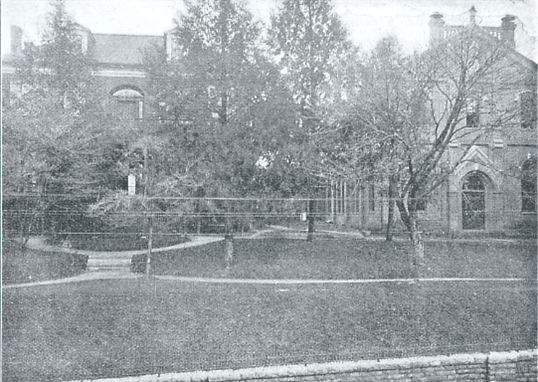
The Floyd Mansion (left) behind "splendid oaks." The new building is to the right. Note the stone wall. Image is from Presbyterian of the South.
Bricks and Mortar
In 1868 The S.J.I. trustees purchased the former home of Governor John B. Floyd for the new school. Described as “palatial,” the three-story brick structure was built in 1833. Photos show little of its appearance since it was located “in the midst of a stand of splendid oaks.” For more than twenty years it met the needs of the small school for classrooms, dormitory, dining hall, administration, and assembly. But as boarding students increased, S.J.I. added a new three-story brick building just to the east of the Floyd building. Still later, a two-story building, which appears to be a dormitory, was added to the west. Appropriately, the entire campus was surrounded by a stone wall.
After the fire of November 1914 destroyed the campus, Stonewall Jackson College began a new campus to the northeast on what is today Barter Drive. McMillan Hall, a dormitory, was completed in 1916, using bricks from original buildings. Three other buildings—including Abingdon Hall—followed in 1921, the college the finest gymnasium and auditorium in the area. A 1944 tornado damaged the four buildings. Today the remaining building are adjunct structures for Barter Theater.
Sports
School colors: Purple and Gold
The Floyd campus lacked space for games. However, physical culture was a focus of the curriculum. In 1870 The Virginian reported that the calisthenics class would give “an exhibition of their Calisthenic exercises and such other entertainment as may serve to amuse their friends.”
In 1915 the Virginian noted that with the new campus, “basketball grounds and golf links were attractive features.” But it was not until 1924 that the new gymnasium allowed SJC to make basketball an indoor sport. So, while the first listed basketball game was in April of 1920 against Sullins College, it was not until 1924 that the girls began to play more than an occasional game. The standard yearly schedule was 6-8 games against Emory & Henry, Sullins, Milligan, Tusculum, Centenary (TN), and what are today East Tennessee State, and Concord (WV).
The article (right) is from the Bristol (TN) Herald Courier.
Note: Images are used in accordance with their “terms of use,” as I understand those terms. Recopying or reproducing may be restricted or forbidden.
